inquiry
Inquiry
Form loading...
0%

Choosing a Precision Cnc Lathe is rarely about finding the largest machine or the longest feature list. It is about matching accuracy, rigidity, control, and service support to real production demands. A compact workshop may value a small footprint, while an automotive supplier may need stable cycle times across thousands of parts. The right decision begins with evidence, not attractive brochures.

Practical evaluation should examine spindle runout, positioning repeatability, thermal stability, and tool-changing consistency. Ask for inspection reports, factory test results, and clear tolerance data. Better still, observe a test cut using material similar to your own work. Watch the surface finish under proper lighting. Measure the finished diameter after the machine reaches operating temperature. Small details reveal large weaknesses.

Operator experience also matters. A technically advanced lathe can become expensive if programming is confusing or maintenance access is poor. Check control training, spare-part availability, installation requirements, and response times from the supplier. No checklist is perfect. Unexpected vibration, coolant behavior, or software limitations may appear only during daily use. That is why experienced machinists should join the selection process. Their practical questions often expose risks engineers overlook. A reliable Precision Cnc Lathe should improve repeatability without creating new production problems. Do not trust promises alone. Compare documented performance, total ownership cost, and long-term support before committing to the purchase.
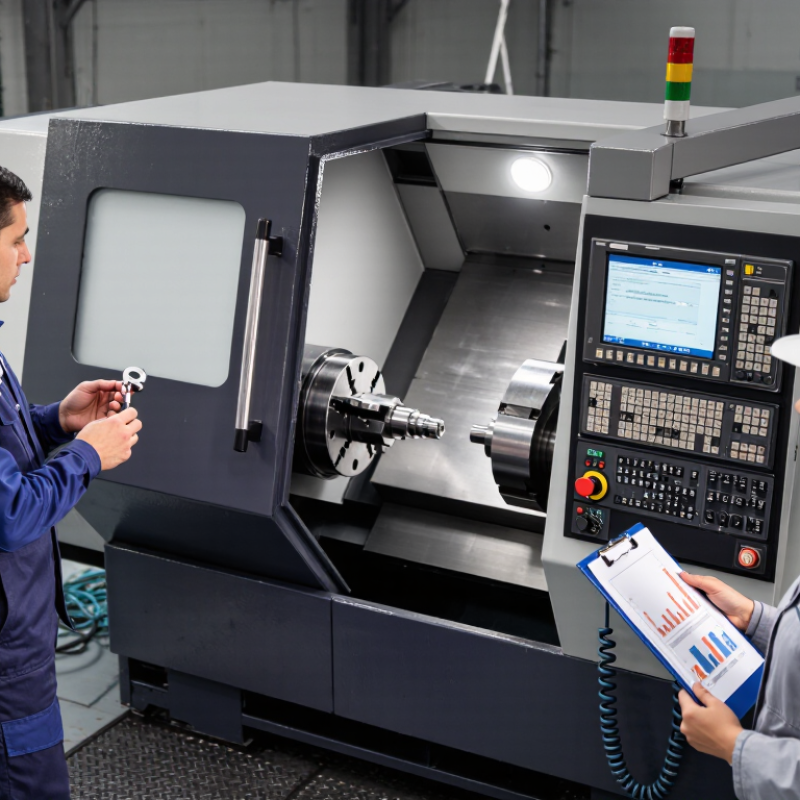
7 Tips for Choosing a Precision CNC Lathe?

Define the Machining Requirements and Part Specifications

7 Tips for Choosing a Precision CNC Lathe

Define the Machining Requirements and Part Specifications

Before choosing a precision CNC lathe, describe the part in measurable terms. Record the material, diameter, length, tolerance, thread type, and surface-finish target. A vague drawing creates expensive guesses.

Consider the production quantity, too. A prototype may need flexible tooling, while repeated batches require stable cycle times. For a Cnc Precision Automatic Lathe, check whether the bar diameter matches your raw material. Also confirm spindle speed, motor power, chuck capacity, and available tooling positions. These details affect cutting stability more than impressive specifications.

Look closely at the part’s difficult features. Deep bores, slender shafts, interrupted cuts, and tight concentricity requirements demand different machine capabilities. Specify the required runout, not only the outside diameter. If a shaft needs 0.01 mm concentricity, the machine, workholding, and inspection method must support that figure.

Do not trust assumptions.

I have seen teams select a machine by maximum turning diameter alone. Later, the tailstock travel or boring-bar clearance caused delays. Review a sample process sheet with an experienced machinist. Estimate tool life, chip control, loading time, and inspection points before requesting quotations. Leave room for uncertainty; material hardness can vary between batches. Recheck every tolerance against the actual function of the part, because a tighter number is not always a better specification.

Evaluate Lathe Accuracy, Repeatability, and Structural Rigidity

Choosing a precision CNC lathe starts with evidence, not a glossy specification sheet. Accuracy describes how closely a cut reaches the programmed dimension. Repeatability shows whether the same command produces the same result again. Ask for test data measured under stated conditions. Thermal growth, tool wear, and operator setup can change those numbers. A 20 mm shaft may pass once, then drift several microns after hours of cutting. Small details matter. Request a sample inspection report, including measurement equipment, temperature, and test location.

Tip: Check structural rigidity during realistic cutting tests. A heavy bed, short load path, and well-supported spindle reduce chatter. Look for stable surface finish at the feeds and depths your parts require. Listen for a sharp, irregular vibration. That sound is a warning. Compare spindle runout at the nose and farther along a certified test bar. Excess movement can cause taper, poor roundness, or inconsistent bore size. For a Precision Gang Tool Cnc Lathe, inspect gang plate stiffness and tool clamping closely. A rigid layout helps only when tools remain firmly seated.

Tip: Separate factory accuracy from production repeatability. Run a warm-up cycle, machine several parts, and measure them in sequence. Record drift, not only the best result. Ask how calibration is verified and how often geometry compensation is checked. ISO 230-style testing offers a disciplined reference, but your material and cycle time remain decisive. One overlooked issue is foundation quality. An excellent machine can lose consistency on a weak, vibrating floor. Leave room for doubt. Test the lathe with your actual bar stock, tooling, coolant, and inspection routine before approval.

7 Tips for Choosing a Precision CNC Lathe

Evaluate lathe accuracy, repeatability, and structural rigidity before comparing machines.

The chart presents a practical, brand-neutral evaluation weighting for precision CNC lathes. Positioning accuracy and repeatability should be verified through standardized test data, while structural rigidity is assessed by observing deformation, vibration, and surface-quality changes under cutting loads. Thermal stability, spindle performance, machine condition, and serviceability complete the selection review.

Technical checks should be compared using documented test conditions and relevant ISO 230 measurement practices. The percentages are a neutral selection-score framework rather than manufacturer performance claims.

Choose the Right Spindle Speed, Power, and Workholding System

7 Tips for Choosing a Precision CNC Lathe

Choose the spindle speed from the cutting tool, material, diameter, and required surface finish. A small diameter may need higher speed, while a large workpiece can become unstable quickly. Use the manufacturer’s cutting data as a starting point, then adjust through controlled test cuts. Do not guess. Watch vibration, heat, chip shape, and finish marks. Keep it measurable. A spindle with a wide speed range is useful, but maximum speed alone does not guarantee precision.

Spindle power must match the toughest operation, not only light finishing. Check continuous power, torque at lower speeds, and acceleration under load. Power matters. A machine may show impressive peak power but struggle during deep roughing. I once underestimated torque requirements on a stainless-steel job, and the surface finish suffered before the tool failed. That mistake changed how I review motor curves and real cutting conditions. Leave practical reserve for interrupted cuts and tool wear.

Workholding should control runout, distortion, and repeatability. Compare chuck accuracy, jaw contact, clamping force, and compatibility with the workpiece shape. Soft jaws can improve grip, but they need accurate boring and regular inspection. Collets often support small parts well, while hydraulic or pneumatic systems can improve production consistency. Select sensors or confirmation systems when an unsecured part could damage the machine. Also check access for loading, chip removal, and maintenance. A powerful spindle cannot rescue weak workholding. Avoid choosing the cheapest system without testing thin-wall parts, long components, and repeated clamping cycles.

Check CNC Control Features and Programming Compatibility

7 Tips for Choosing a Precision CNC Lathe

Check CNC Control Features and Programming Compatibility

A precision CNC lathe needs more than a sharp spindle and rigid frame. Its control system must match your daily programming methods. Check support for standard G-code, conversational programming, custom macros, canned cycles, and multiple coordinate systems. These features reduce editing time when jobs change. A clear display helps operators spot incorrect offsets before cutting begins. Small details matter.

Request sample programs from your actual parts. Test turning, threading, grooving, drilling, and tool-nose compensation. Run them through the proposed control and your CAD/CAM postprocessor. Do not trust a sales demonstration alone. Run a dry test. Confirm how the control handles alarms, program storage, tool data, and probing routines. File transfer should be stable, traceable, and simple to restore after a fault.

Compatibility problems often appear after installation. A code format may simulate correctly but behave differently on the machine. Ask for documentation, update policies, and operator training. Check whether technicians can edit programs safely at the control. Review backup procedures, password access, and version control. I have found that familiar controls usually shorten training, but this assumption can be wrong for new operators. A slower interface may still be reliable if its logic is easy to verify. Test with real shop conditions, including gloves, coolant residue, and interrupted network access.

7 Tips for Choosing a Precision CNC Lathe? — Check CNC Control Features and Programming Compatibility

Use this comparison framework to evaluate CNC control functions, programming compatibility, production requirements, and verification evidence before purchasing a precision CNC lathe.

Selection Tip Control Feature or Data Dimension What to Check Practical Acceptance Benchmark Recommended Verification
1 Confirm programming compatibility G-code format, program transfer, and postprocessor support
  • Support for ISO 6983-style G-code commonly used in turning.
  • Compatibility with the shop’s CAM postprocessor.
  • Availability of USB, Ethernet, or other approved data-transfer methods.
  • Support for standard turning commands such as tool offsets, canned cycles, constant surface speed, and cutter compensation.
Run one production-ready sample program without manual code rewriting Load a representative program, verify the toolpath in simulation, and perform a controlled dry run.
2 Evaluate interpolation and axis control Controlled axes, interpolation modes, and synchronization functions
  • Number of controlled axes and simultaneous interpolation capability.
  • Linear and circular interpolation in the required work planes.
  • Support for spindle orientation, rigid tapping, and synchronized threading when required.
  • Availability of live-tool or sub-spindle functions for the intended machine configuration.
All required axes and synchronization functions are available in the standard control package Test turning, threading, drilling, and any live-tool operation using the actual machine configuration.
3 Check precision-related control settings Resolution, compensation, interpolation accuracy, and servo tuning
  • Command resolution for linear and rotary axes.
  • Backlash compensation and pitch-error compensation functions.
  • Tool geometry, wear, and work-coordinate offset management.
  • Servo response settings suitable for the machine’s accuracy requirements.
Control resolution should be finer than the required part tolerance Review the control specification, compensation screen, calibration records, and a measured test part.
4 Verify memory and program management Part-program storage, file handling, editing, and revision control
  • Available program memory for large files and repeated production jobs.
  • Support for subprograms, macros, comments, search, copy, and block editing.
  • Clear management of tool data, work offsets, and program revisions.
  • Backup and restore procedures for programs and machine parameters.
Storage capacity should cover the largest expected program plus routine backups Transfer the largest planned program, edit a copy, back up the data, and restore it on the control.
5 Assess macro and automation capability Custom macros, variables, probing, and process monitoring
  • Availability of variables, conditional logic, arithmetic, and subroutine calls.
  • Support for probing cycles or external measurement data when required.
  • Interface capability for bar feeders, part catchers, mist systems, or other peripherals.
  • Alarm handling and interlock logic for automated processes.
Required automation functions should be programmable without external workarounds Demonstrate one macro, one sensor or peripheral input, and the resulting alarm or machine response.
6 Review operator usability and error prevention Interface design, simulation, alarms, and tool-data entry
  • Readable display with clear position, offset, alarm, and program screens.
  • Graphic toolpath simulation or solid-model verification if needed.
  • Single-block, feed-hold, dry-run, and optional-stop functions.
  • Alarm messages that identify the affected axis, block, or parameter.
A trained operator should complete setup with minimal manual code intervention Ask operators to set offsets, verify a program, respond to an alarm, and restart safely after a feed hold.
7 Confirm serviceability and future compatibility Diagnostics, software updates, documentation, and data security
  • Built-in diagnostic screens for drives, I/O, encoders, and communication status.
  • Documented backup procedures for parameters, offsets, macros, and programs.
  • Availability of manuals, electrical drawings, and maintenance instructions.
  • Compatibility with the shop’s network security and removable-media policies.
Complete machine data backup and documented recovery procedure must be available Request a maintenance demonstration, review documentation, and perform a controlled backup-and-restore test.

Evaluation note: Exact control functions, axis configurations, command formats, and available options vary by machine specification. Confirm every requirement using the final technical quotation, control manual, postprocessor documentation, and a witnessed acceptance test.

Assess Tool Capacity, Automation, and Production Flexibility

Choosing a precision CNC lathe starts with the workpiece, not the brochure. Check turret stations, tool height, live-tool power, bar capacity, and clearance around the chuck. A Precision Servo Turret Cnc Lathe may offer twelve stations, yet oversized holders can reduce practical capacity. Measure your real tools, including coolant lines and chip shields. Small details matter.

Automation should match production rhythm. A bar feeder supports long runs, while a parts catcher and probing system reduce operator handling. The International Federation of Robotics reported 541,302 industrial robot installations worldwide in 2023, showing continued investment in automated production. However, automation is not automatically efficient. A poorly planned loader can add adjustment time and create more stoppages. I have seen machines lose hours because part-present sensors were positioned for one inconsistent component.

Production flexibility deserves equal attention. Look for fast turret indexing, accessible setup points, programmable work offsets, and simple changeover procedures. Deloitte’s 2024 Smart Manufacturing and Operations Survey found that 86% of manufacturers view smart manufacturing as important to future competitiveness. That ambition still needs practical evidence. Ask for cycle-time trials using your material, tools, and tolerances. Review tool-life data, chip control, and unattended recovery functions. A machine that performs beautifully on one sample may struggle with mixed batches, short runs, or changing diameters. Leave room for honest limitations.

Compare Machine Footprint, Maintenance Needs, and Safety Features

When choosing a precision CNC lathe, footprint means more than catalog width. Measure the complete working envelope. Include the open door, chip conveyor, bar feeder, and maintenance access. A narrow machine can still consume valuable floor space. Draw its maximum reach on the floor with tape. Then check operator movement, forklift routes, lighting, and floor loading. Leave room for a technician to remove panels without blocking an aisle. Small workshops often underestimate this detail.

Maintenance needs should be compared in labor minutes, not brochure promises. The U.S. Department of Energy’s Operations & Maintenance Best Practices Guide reports that preventive maintenance can reduce costs by 12–18% compared with reactive maintenance. Ask about lubrication intervals, coolant filtration, chuck cleaning, belt inspection, and control-system backups. A five-minute daily wipe matters. Also calculate access time for spindle, turret, and electrical components. I have seen maintenance plans fail because the service panel opened into stored material. That mistake was avoidable.

Safety features deserve physical testing. OSHA 29 CFR 1910.212 requires suitable machine guarding, while the U.S. Bureau of Labor Statistics recorded 5,283 fatal workplace injuries in 2023. That figure is not CNC-specific, but it reinforces disciplined risk control. Check door interlocks, emergency stops, guarded chucks, chip containment, safe restart behavior, and clear viewing windows. ISO 13849-based controls can support safer designs when properly validated. Do not trust a glowing safety icon. Test the machine under realistic loading, because ideal demonstrations rarely expose awkward reaches or poor visibility.

Review Supplier Support, Total Cost, and Long-Term Reliability

When choosing a Precision Cnc lathe, supplier support deserves the same attention as spindle speed. Ask who answers during a night shift, how quickly critical parts ship, and whether technicians can diagnose alarms remotely. A practical supplier should provide installation records, training hours, preventive-maintenance schedules, and clear response times. The 2024 Deloitte Manufacturing Industry Outlook identifies talent shortages and production resilience as major industry concerns. Strong technical support reduces both risks.

Look beyond the purchase price. Calculate tooling, energy, software updates, calibration, coolant, operator training, and expected downtime. The 2023 World Machine Tool Survey reported global machine-tool consumption at approximately 81.9 billion dollars, showing the scale of capital investment in this sector. Yet a low initial quote may conceal expensive options or weak service coverage. Check the warranty exclusions carefully. Small details matter.

Energy also affects total cost. The U.S. Department of Energy reports that compressed-air leaks can waste 20% to 30% of compressor output in poorly maintained systems. A lathe may not use compressed air heavily, but auxiliary equipment still adds cost. I have seen buyers compare cycle times while ignoring service travel and spare-part delays. That was a mistake. Request a five-year ownership estimate, including realistic maintenance intervals and local labor rates. Reliability should be proven through reference calls, documented accuracy tests, and repeatability results after extended production. Sales promises alone are not enough.

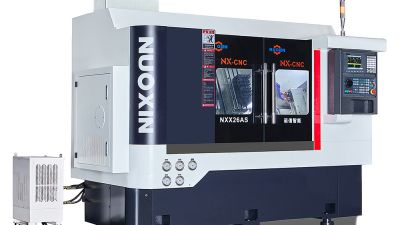
CNC Lathe Market Insights from Grand View Research: Evaluating the NXX-26AS Dual-Gang Twin-Spindle Advantage

Grand View Research’s CNC machine market analysis highlights rising demand for automation, higher machining accuracy, and reduced cycle times across automotive, aerospace, electronics, and precision-component manufacturing. The NXX-26AS dual-gang twin-spindle CNC lathe addresses these priorities by enabling coordinated operation between the main and sub-spindles. This configuration can support simultaneous or sequential machining, reduce workpiece transfer requirements, and improve throughput for complex turned parts. Its intuitive advanced CNC control platform also supports efficient programming and straightforward shop-floor operation.

The machine is engineered with rear-mounted motorized spindles using ultra-precision P4-grade bearings, providing stable high-speed rotation, strong durability, and reduced vibration. Independent spindle servo drives deliver rapid dynamic response and robust torque, while synchronized X1/X2/Z1/Z2 axes promote smooth motion and accurate chip removal. Precision C3-class ball screws, Japanese precision bearings, and high-grade linear guides enhance transmission accuracy and rigidity. A high-strength cast-iron bed and base further improve vibration damping and dimensional stability during demanding production runs.

Industry 4.0 research from MarketsandMarkets identifies connected automation, process consistency, and flexible production as major drivers of modern machine-tool investment. In line with these trends, the NXX-26AS incorporates dependable electrical control components and a stable hydraulic system designed for simplified maintenance and long service life. Standard specifications can be customized or upgraded, allowing factories to adapt spindle performance, tooling, control functions, and workholding solutions to specific manufacturing requirements.

FAQS

What should I check before choosing a precision CNC lathe?

Start with your actual workpiece. Check turret stations, tool height, live-tool power, bar capacity, and chuck clearance. Measure tools with coolant lines attached. Catalog capacity can look better than real capacity.

Does a twelve-station turret always provide enough tool capacity?

Not necessarily. Oversized holders may block nearby stations. Chip shields and coolant hoses also consume space. Test your complete tool setup before deciding.

Which automation features can reduce operator handling?

A bar feeder supports longer production runs. A parts catcher can reduce manual unloading. Probing systems help verify positions and dimensions. Poorly placed sensors may create repeated stoppages.

How can I judge whether automation will improve production?

Match automation to your production rhythm. Request cycle-time trials using your material, tools, and tolerances. Review adjustment time, recovery functions, and sensor reliability. Automation is not automatically efficient.

What features make a CNC lathe more flexible?

Look for fast turret indexing and accessible setup points. Programmable work offsets can simplify changing diameters. Easy changeovers matter during short runs. A machine that excels on one sample may struggle with mixed batches.

How much floor space does a CNC lathe really need?

Measure the full working envelope, not only the machine body. Include the open door, chip conveyor, bar feeder, and maintenance access. Mark the reach with floor tape. Leave clear paths for operators and technicians.

Which maintenance details should I compare?

Compare labor minutes, not only service intervals. Check lubrication, coolant filtration, chuck cleaning, belt inspection, and control backups. A five-minute daily wipe can prevent larger problems. Service panels should open without blocking an aisle.

What safety features should be tested before purchase?

Test door interlocks, emergency stops, guarded chucks, and chip containment. Check safe restart behavior and viewing visibility. Test realistic loading conditions, not only a polished demonstration. A bright safety icon proves very little.

Conclusion

Choosing a Precision Cnc Lathe requires more than comparing basic specifications. Start by defining the required materials, dimensions, tolerances, surface finishes, and production volume. Then evaluate the machine’s accuracy, repeatability, rigidity, spindle speed, motor power, and workholding options to ensure stable performance under real cutting conditions. The CNC control system should support your programming methods and provide useful functions for setup, monitoring, and process adjustment.

Also consider tool capacity, automatic tool changing, bar feeding, and other automation features that can improve productivity and flexibility. The machine’s footprint, maintenance requirements, accessibility, and safety systems should match your facility and operating capabilities. Finally, review supplier training, technical support, spare-parts availability, energy use, purchase price, and expected operating costs. A well-balanced decision should focus on long-term reliability, consistent part quality, easy maintenance, and the machine’s ability to support future production needs rather than on initial cost alone.

Emma

Emma

Emma is a dedicated marketing professional at a high-tech enterprise established in 2004, specializing in precision processing equipment. With a deep understanding of the industry, Emma excels in showcasing the company's advanced products, such as CNC numerical control lathes, turning-milling......
Previous Who Are China’s Top 10 CNC Vertical Lathe Manufacturers?